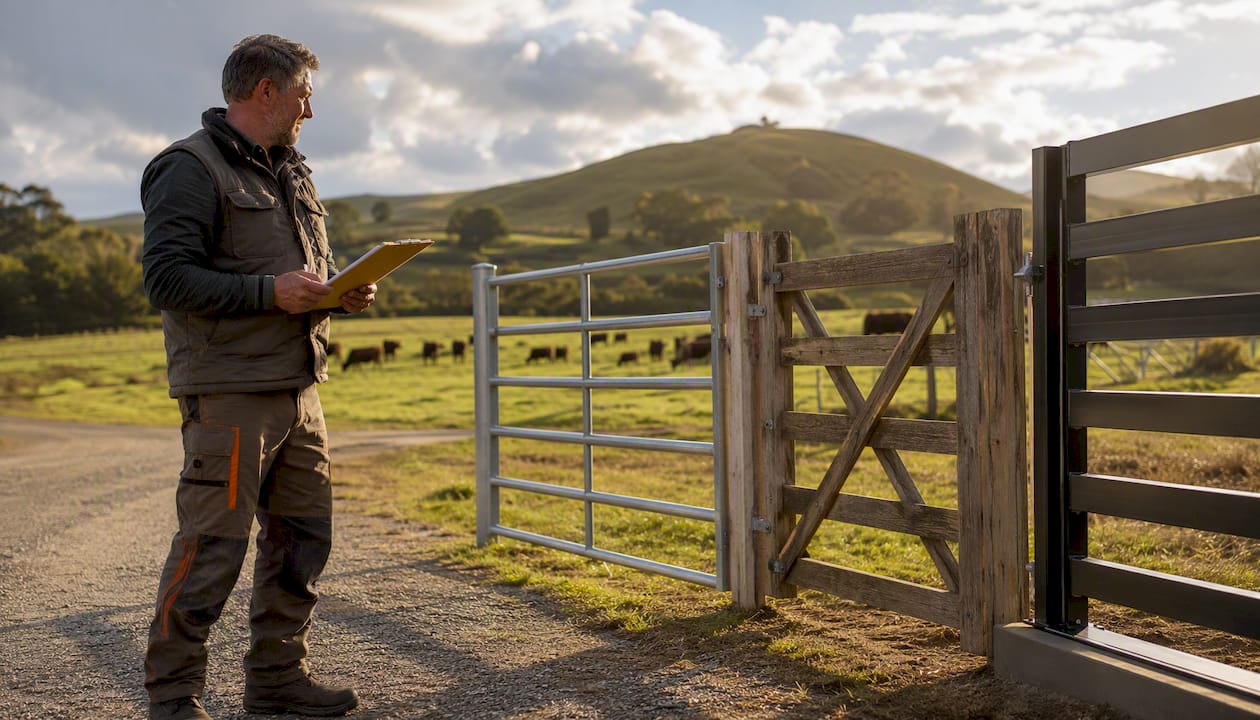
A farm gate needs to suit everything that passes through the opening and everything it must keep contained. Cattle generally require a strong, well-braced gate with secure hardware. Sheep need smaller openings, particularly near ground level. Horse gates should be visible and free from unnecessary projections or trapping points. Machinery gates require sufficient clearance for the widest vehicle, implement or load using the entrance.
The gate itself is only one part of the installation. Width, height, rail spacing, ground clearance, posts, hinges and latches all affect how well it performs. Here’s how to choose one.
Start With the Main Purpose of the Gate
As you begin exploring farm gates, start by analysing how the entrance will be used most often. A paddock entrance used by cattle has different requirements from a gateway that serves tractors, horse floats or hay equipment.
Consider:
- The type and size of livestock
- The widest vehicle or implement
- How often the gate will be opened
- Whether animals gather or push near the entrance
- The slope and condition of the ground
- The strength of the hinge and latch posts
- Whether the gate must serve livestock and machinery
For mixed-use entrances, base the opening on the largest machine while making sure the rail spacing, gate height and ground clearance remain suitable for the smallest animal.
Farm Gates Compared
| Main use | Suitable characteristics | Main priority |
| Cattle | Strong frame, effective bracing and secure latch | Resistance to repeated pressure |
| Sheep | Mesh or smaller lower openings | Containing sheep and lambs |
| Horses | Visible rails, smooth surfaces and limited trapping points | Reducing avoidable injury risks |
| Machinery | Wide clear opening and well-supported frame | Vehicle and implement clearance |
| Mixed use | Livestock-suitable construction sized for the largest machine | Balancing access and containment |
These are general principles rather than fixed specifications. Property layout, animal behaviour, soil conditions and traffic frequency should also be considered.
What Type of Farm Gate is Suitable for Cattle?
For cattle, prioritise frame strength, dependable hardware and posts capable of supporting the gate over time.
Cattle can place considerable pressure on gateways, particularly near yards, feeding areas and frequently used paddock entrances. A rigid rail gate with sound bracing is usually more appropriate than a light gate intended for occasional access.
A livestock farm gate should be paired with a latch that cannot be easily pushed or lifted open. The hinge post must also carry the gate without leaning or allowing the latch end to drop.
For gateways connected to holding areas or permanent yards, galvanised cattle rail may also form part of the surrounding enclosure. Check the dimensions and intended application of each component before installation.
What Type of Gate Works Best for Sheep?
Sheep gates need smaller openings than many standard cattle gates, especially close to the ground.
A gate may contain adult cattle while leaving enough space for sheep or lambs to pass through or become caught. Mesh, closely spaced rails or a suitable lower infill can reduce this problem. The gap below the gate and the space beside the latch post also need attention.
On uneven ground, measure the opening at several points. A gate that has suitable clearance at the hinge end may leave a much larger gap at the opposite end.
For pens and handling areas, sheep yard mesh with smaller openings may be relevant to the wider enclosure design. The gate and adjoining fence should work as one continuous boundary rather than leaving weak points around the entrance.
What Makes a Farm Gate More Suitable for Horses?
A horse gate should be visible, smooth and free from avoidable projections or openings that may catch a hoof, leg, halter or rug.
Inspect welds, rail ends, latch components and hinge fittings. The gate should be high enough for the horses being contained, while the lower clearance should not create an obvious trapping or escape point.
The entrance also needs enough room for a horse to pass without being crowded against a post or latch. Safe Work Australia advises controlling access to horse-keeping areas and considering safe gate operation within yards.
Purpose-made horse gates allow horse owners to compare designs separately from general livestock gates. The entire installation should still be checked regularly for bent rails, loose hardware, corrosion and ground movement.
How Wide Should a Machinery Gate Be?
A machinery gate should be wider than the largest tractor, attachment, trailer or implement that regularly uses the opening.
Measure equipment in its widest normal transport or working configuration. Include mirrors, mower decks, buckets, spreaders, trailers and other attachments. Extra clearance is particularly important when the approach is angled or the vehicle must turn immediately before entering.
Also check:
- Whether the gate can open fully
- The direction of the swing
- Rising or falling ground
- Space for a single long gate
- Whether paired gates would be easier to support
- Possible future changes in equipment
A narrow gate may technically fit the tractor but still be inconvenient when towing an implement.
Five Farm Gate Specifications to Compare
1. Clear opening width
Measure the usable space between the posts, not only the length of an existing gate. Allow for hinges, latches and required operating clearance.
2. Height and opening size
Gate height, rail spacing and lower clearance affect containment. Smaller livestock generally require closer openings than cattle.
3. Frame and bracing
Long gates place greater loads on their hinges and posts. Bracing helps the frame retain its shape under regular use.
4. Surface finish
Galvanised and powder-coated gates differ in appearance, exposure protection and maintenance needs. Consider local conditions and how frequently the gate may be knocked or scraped.
5. Posts, hinges and latches
Even a suitable gate can sag or become difficult to close when installed with inadequate hardware. Compare adjustable farm gate hinges and secure latches against the gate weight, post material and required swing.
Avoid these Mistakes When Selecting Farm Gates
Common mistakes include:
- Measuring the old gate instead of the clear opening
- Forgetting the width of machinery attachments
- Using wide cattle-style openings for lambs
- Leaving unsafe projections around horse entrances
- Installing an undersized hinge post
- Failing to account for sloping ground
- Choosing hardware without checking gate weight
- Assuming hinges and latches are included
- Allowing the gate to obstruct a road, track or work area when open
Taking measurements and checking the full entrance before ordering can prevent many of these issues.
Making the Final Choice
Choose a cattle gate for strength, a sheep gate for smaller openings, a horse gate for visibility and reduced trapping points, and a machinery gate for clear usable width.
For a shared entrance, start with the widest machine that must pass through it. Then check that the gate height, rail or mesh configuration, bottom clearance and latch remain suitable for the livestock.
Frequently Asked Questions
What is the best farm gate for cattle?
A strong, well-braced rail gate with suitable posts, hinges and a livestock-resistant latch is generally appropriate. The final choice should account for cattle size, pressure around the gateway and frequency of use.
Do sheep need a mesh farm gate?
Mesh or smaller lower openings can help contain sheep and lambs where wide rails may leave escape or trapping gaps. Check the spaces below the gate and beside both posts as well.
What is the safest type of gate for horses?
Horse gates should be visible and have smooth construction, sound welds and minimal projections or trapping points. The gate, latch and adjoining fence must be assessed as one complete enclosure.
How much clearance should a machinery gate have?
The clear opening should exceed the widest normal configuration of the tractor, implement, trailer or load. Additional space is needed where the approach is angled, uneven or requires a tight turn.
Can one farm gate serve livestock and machinery?
Yes. Size the opening for the largest vehicle or implement, then confirm that the gate’s height, lower clearance, rail spacing, latch and adjoining fence remain suitable for the livestock being contained.
About the Author